Business stewardship · Local business owners
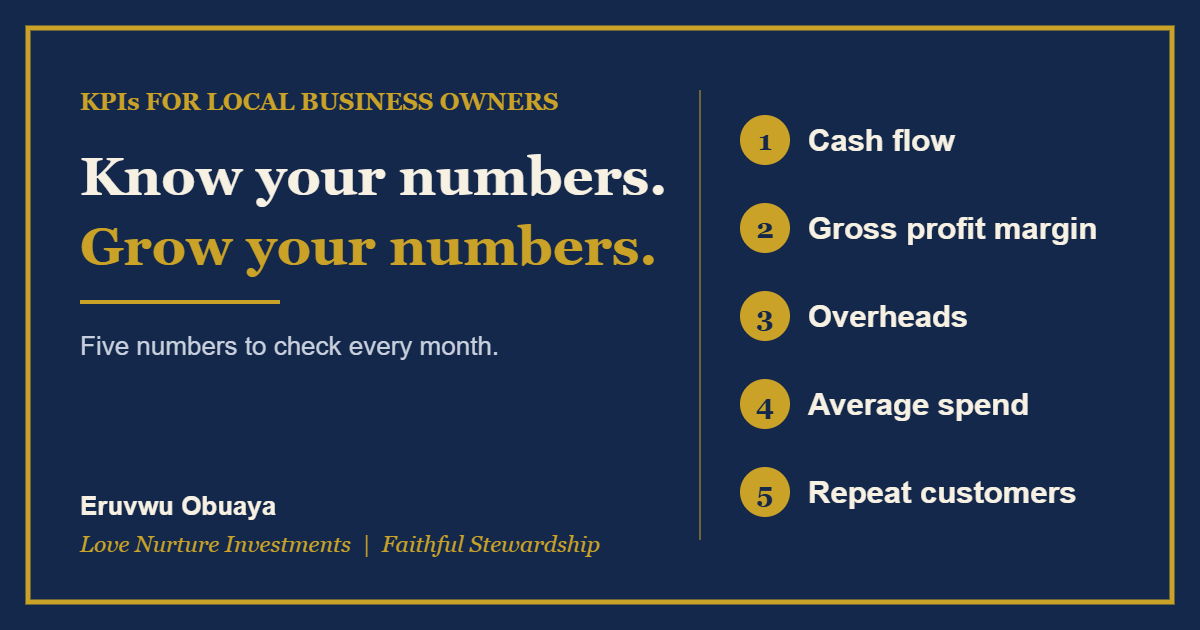
Know your numbers. Grow your numbers.
Being busy and getting ahead are not the same thing. Five numbers, checked once a month, will tell you which one your business is doing.
Eruvwu Obuaya · · 5 min read
First things first
What is a KPI?
A key performance indicator, or KPI, is a number that tells you, month by month, whether your business is on track. Busy is not a KPI. A full diary, a ringing phone and late nights can all sit alongside a business that is quietly going backwards. Numbers show you what the busyness is producing.
“Be thou diligent to know the state of thy flocks, and look well to thy herds.” Proverbs 27:23 (KJV)
Knowing the state of your flocks is stewardship. You cannot look after well what you never look at.
- Cash flowWhat came in against what went out.
- Gross profit marginWhat you keep from each sale after direct costs.
- OverheadsThe fixed costs that quietly eat profit.
- Average spend per customerWhat each customer is worth to you.
- Repeat customersHow many come back.
KPI 01
Cash flow
Profit on paper does not pay the rent; cash in the bank does. Each month, total the money that came into the business account and the money that went out.
Cash flow = money in − money out (for the month)
A negative month is not a disaster, but two or three in a row is a warning light. Watch the trend, not just the single month.
KPI 02
Gross profit margin
This is what you keep from each pound of sales once you have paid for the things that go directly into what you sell: stock, materials, products.
Gross profit margin = (sales − direct costs) ÷ sales × 100
If your margin is shrinking, either your costs have crept up or your prices have not kept pace. Both can be fixed, once you can see it.
KPI 03
Overheads
Overheads are the costs you pay whether you sell anything or not: rent, energy, broadband, phones, insurance, software and subscriptions. They are easy to set up and easy to forget.
Overheads as a share of sales = monthly overheads ÷ monthly sales × 100
Go through your statement once a month. Cancel what you no longer use, and check every contract that is coming up for renewal.
KPI 04
Average spend per customer
This tells you what each customer is worth to you on a typical visit or order.
Average spend = total sales ÷ number of sales
Raising it does not have to mean raising prices. A well-placed add-on, a bundle, or a useful extra service can all lift it.
KPI 05
Repeat customers
It usually costs far less to keep a customer than to find a new one. How many of this month’s customers have bought from you before?
Repeat rate = returning customers ÷ all customers × 100
If you do not record this yet, start simply: a loyalty card, a booking system, or a tally on the counter.
How many?
Fewer numbers, more action
Most small businesses do well with five to eight KPIs, reviewed monthly. A long list nobody reads helps no one. Pick your five, put them on one page, and give yourself twenty minutes on the same day each month to fill them in and decide one thing to change.
How I can help
Two ways to move your numbers this month
If you run a local business with regular customers (salon, barber, café, shop, studio, trades, club), here is what I can offer.
1. A free KPI conversation
We look at your five numbers together and find the one to work on first. Email [email protected] with “KPI” in the subject, or comment “KPI” on my LinkedIn post, and I will be in touch.
2. Lift what each customer is worth to you, without raising your prices
As a Utility Warehouse Partner, I can register your business as a UW Connector. It is free to join and there is no selling: you mention Utility Warehouse to your customers and pass interested people to me, and I do the rest. Utility Warehouse’s published rewards are £25 to £150 for each homeowner you introduce who becomes a qualifying customer, depending on how many services they take.
Earnings are not guaranteed and are taxable: Connectors declare them to HMRC. Disclosure: I am a Utility Warehouse Partner and I am paid when people join through me. Details correct at the time of writing.
Your next step
Find out where you’re being asked to be faithful.
Seven quick questions, multiple choice, about two minutes. There’s no wrong answer: it simply shows you where to start.
Go deeper with A Study in Personal Finance
A 30-day study in four courses, each day grounded in scripture, with a reflection question and an action step. Read the first three days free by email.
Kit will ask you to confirm by email. Unsubscribe any time.
You’re almost in. Check your inbox for a confirmation email from Kit, and the first three days will be on their way.
- The workbook, £20. All thirty days, digital or printed.
- The guided 5-week study, £197. Work through the study with me, with live sessions.
Questions? Email [email protected].
This is Bible-based education, not financial advice. For decisions about debt, tax or investments, speak to a qualified adviser.
Faithful in the little, and in much, Eruvwu